
How to use Squidoo to promote your ebook

When it comes to marketing, I’m a firm believer of promoting in as many places as possible. The internet makes this quite easy as you can sign up to article websites and PR providers all over the place, helping to spread your author name and novel titles. Increased exposure helps to build both branding and awareness, and so getting as many mentions across the Internet is a GOOD thing.

I should say before I continue, that Squidoo is no quick fix or easy way to promote your ebook. Like most other platforms, it requires time and patience, and if you’re looking to only invest a couple of hours on squidoo and reap huge benefits, then you’re probably wasting your time. It’s probably not the best way to market a book, and I’m also fairly new to the website so I’m not a pro either. It’s a huge time sap too, and I’ve been spending hours on there over the past few days when I could have been doing better things. However, I like to take a time out between writing books to formulate plans, and squidoo has been quite fun to use, hence this post. In addition, recent reports listed by the site showed that it was the 64th most visited website in the US, and gained 2 million hits in just one day this year, so there is big potential to attract readers.

BUT, what exactly is Squidoo?

Simply put, squidoo is a website where you create articles (called lenses) about specific topics using the platform’s ready built webpages and modules. Think Ezine Articles, About.com etc. Anyone can join, anyone can build, and the best feature is that anyone can earn money from their Amazon modules. Amazon modules that can point directly to your books.

HOW can it help me promote?

The best way Squidoo can help you promote your books is by building an online encyclopaedia of your work. You can create lenses for your books, link these to lens of your characters, or places, or book themes. Think Wikipedia, but a wiki for your work created by you.

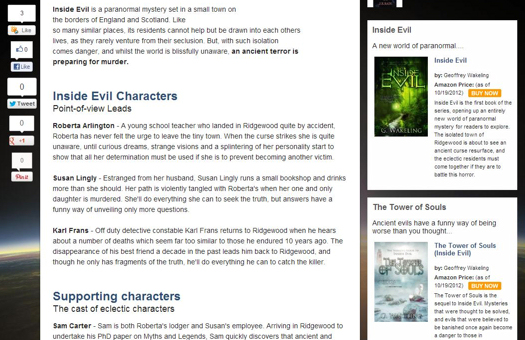
So far I’ve created an Inside Evil lens, The Tower of Souls lens and several others. I’ve linked them together. I’ve added Amazon links, a poll of favourite characters, a simple cast list and a ‘Did you know?‘ section.
 

The more ‘likes’, comments, tweets etc that you get for a page, the higher it’s visibility becomes. And, of course, in the same way that you should be commenting on blogs, responding to tweets, and pasting FB marketing material to promote your book every day, a few updates on your lenses can work wonders. Once you’ve spent the time creating, you can simply check in every day, update, respond to comments and factor the time into your marketing schedule.

EARN points and level up

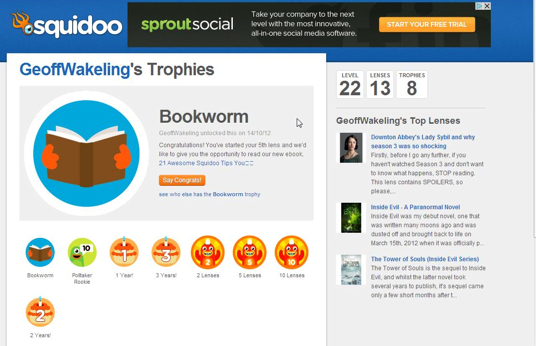
Whilst Squidoo isn’t a game as such, you do start at level one and earn points as you go. These points are equal to expertise, and each time you level up, you unlock new features for your lenses and additional ways to climb up the community ladder. It’s a fun side to squidoo, and you’ll keep wanting to earn points like mad just to see what’s waiting. You can breathe a sigh of relief when you reach level 85 as that’s the top, but as I’m currently only 22, there’s a fair way to go.
BEWARE,  it’s a time suck

Like many social platforms, Squidoo is a total time suck and isn’t for everyone. You need to enjoy the experience of making lenses and taking part in the community if you’re to benefit at all. Looking at it only as a promotional tool probably won’t work. In addition, you’ll probably need to create more lenses than just your book ones, and this means that you need to actually enjoy using the website. I’ve created lenses in Pets,  Entertainment and How To as a way to draw traffic to my profile and build my squidoo presence.

I’m not advocating that squidoo is about to be a ground-breaking new promotional too, but I’ve enjoyed using it over the past couple of days. If it proves successful, I’ll drive traffic towards my books whilst earning commission on their sales (and any other items I add to my Amazon modules). If you have some spare time, then take a look. You can find my profile HERE, and start exploring this world of virtual squids.

Correcting my author name

I’ve learned a lot in the past seven months of self publishing. Oh, how daunting everything seemed way back in April, and now I have two novels on Amazon shelves and another on the way. However, if there’s one thing I haven’t been careful about, it’s my author name. Continuity is key when you’re developing a platform and creating a brand for yourself, so your author name should also be constant. Unfortunately, in my case, this isn’t true, and it’s got me into quite a pickle.

If Joanna Rowling suddenly published a new Harry Potter book, you might think that it was fan fiction. After all, she is known as J.K. Rowling by millions of people around the world, and it always seems a little odd to hear her called Joanna. Likewise, if an S. Myers released a new fantasy novel, it wouldn’t be instantly obvious that it was the same Stephanie Myers who wrote the Twilight Saga.

Having been attempting to upload my books to Kobo, and hence going through the manuscripts again, I realised that there was no continuity with what I called myself. I was Geoffrey Wakeling here, Geoff Wakeling there, and G. Wakeling on the front cover. It might seem like a small issue, but it’s importance has been highlighted with my recent creation of paperbacks via CreateSpace. My kindle books are listed on Amazon as written by Geoffrey Wakeling. However, my CreateSpace novels are Mr. G. Wakeling, and that has led to some confusion over linking.

From now on, I really need to start paying attention to keeping continuity and will be going through all my literature to correct my author name to G. Wakeling. Call me what you like, and I’ll respond as long as I know that it’s me you’re talking too. But, creating a constant author name is vital if you’re to create that all important branding and it seems that I’ve not been nearly careful ensuring in creating my author name platform.

How to market your ebook in your email signature

I’ve been marketing Inside Evil in my email signature ever since it was available for sale. There’s nothing like a subtle sales pitch for getting the attention of people, and if you include a link to your books in an email, you may find that people will naturally click the link and take a look. After spending a few minutes placing the link, you’ve got a marketing plan that keeps on working (as long as you send emails, of course), and whether you’re emailing friends, family or new associates, you have the chance to make a sale or at the very least, stir some interest.

I always just used a text link in my email – it’s easy and simple to do. I use hotmail most of the time, so adding a little piece of text and including a hyperlink to my Amazon page seemed obvious enough. However, for no specific reason at all, I decided today that it wasn’t enough. OK, so people might look at the link, but it didn’t exactly leap out of the page.

After dabbling around in hotmail I realised that, much like on a website, I could use HTML to actually put in a sales image containing a specific sales link. All you need is to create your banner, have somewhere available to upload your image to the web so that it has an URL, use some rudimentary HTML, and off you go.

Firstly, I created a quick sales image that would be sure to catch people’s eye when they get an email from me:

You don’t want it to take up too much space, so this image is just 150px x 700px.

Secondly, I uploaded the image to this website’s media centre so that I could get an URL for the picture. This is important because hotmail doesn’t allow you to upload an image into your signature directly. However, it does offer HMTL, which means that you can link to an image anywhere on the web.

Thirdly, I used a simple piece of HMTL code to paste the image and link into my signature:

<a href=”http://www.amazon.com/dp/B007JIH0EU” target=”_blank”><img src=”https://geoffreywakeling.com/wp-content/uploads/2012/09/sig.jpg” border=”0″ width=”700” height=”150“></a>

You can see that the red text indicates where the image links to. I thought about linking directly to my Amazon author page but thought I’d try a direct Inside Evil link first. It’s easy enough to change around, so I can alter it at my preference.

The blue text indicates where in my wordpress directory the image is held. This doesn’t have to be your blog, it could be photo service such as Photobucket, but your image must have an URL.

Finally, the green numbers show the size of the image so that you can set your picture to your own dimensions.

I have no idea where this will work, but it’s sure to be more eye catching than a simple written signature link with a hyperlink installed. Now, when people open my email, they’ll (hopefully) be drawn towards the covers and want to find out more.

Book Promotion; The importance of thinking outside the box

I know I keep harping on about promoting and getting book sales, but unless you’re one of those lucky few who release a few novels and then see sales sky-rocket, you’re like me and have to contend with the Amazon Beige Bar of Shame (BBOS) for many weeks and only a trickle of customers. I’ve tried advertising on Goodreads and doing a LibraryThing giveaway, but to no avail (though I have had a few good reviews from the latter option). I’ve tried posting, not spamming, on forums, but haven’t seen any direct sales as a result. I’ve used Twitter to my advantage and have found a handful of new customers here, and word of mouth (mostly by my sister) has got me the majority of my sales.

There was a nice thread on Kindle Boards called ‘Places to Promote Your Book‘ and I took advantage of some the listed options to sign up at Novelscribe, and place very cheap promotions at YourBookAuthors.com and BestIndieBooks.com. When I say cheap, I mean it, and I think I only paid around $15 in total for both the features – it’s not exactly going to break the bank. Nor is it going to get huge exposure, but only a few extra eyes seeing my work could be beneficial.

I’ve increasingly been thinking about how important it is to think outside the box and create a stir, a buzz. Placing a banner on a high traffic website is all well and good, but how many people actually click that link and then buy a book? Branding strategists and advertisers keep banging on about how important engaging with customers is, isn’t it about time us indie authors followed suit? Engaging with readers and potential fans isn’t just about tweeting replies and creating a fan pages though. It’s about really trying something new and innovative to capture people’s attention.

I’ve had a couple of ideas over the past few weeks for marketing ploys which could be fun for people to take part in and could increase book sales. When it comes to thinking outside the box, I think it’s best to think global, to think all conquering, to think of ways to go viral on the internet and become a sensation. I doubt that either of my ideas will do this, but they might work in creating more of a buzz than a simple website banner or Goodreads advert.

Exclusive Content

Rewarding readers and luring new customers in can be done with providing a worm on the end of that newsletter fishing hook. I’ve seen many people talking about getting subscribers onto their newsletters by offering free books and giveaways. However, I’ve also seen authors saying that as soon as their giveaway is over, people un-subscribe, defeating the object of the exercise.

To counter this, I’ve developed a little plan for creating ongoing exclusive content only for newsletter subscribers. I was playing Mass Effect the other day, collecting codex’s as I went, and I suddenly thought ‘I could offer codex’s for my Inside Evil series.‘ The codex system is basically like an encyclopedia, and in Mass Effect you collect titbits of information relating to characters, places, weaponry, lore, as you journey through the game. This helps you become more involved in gameplay and really creates a gripping universe to explore.

Being the complete nerd that I am, I already have a lot of notes on characters, hotspots, creatures etc that appear in the Inside Evil series, some of which is never even mentioned in the book. So, I’m currently developing my own series of codex’s that will be released on a monthly basis to newsletter subscribers. These will give tasty extra information for fans to enjoy, and for die hard fans, they’ll be downloadable so that the image codex’s can be kept and collected. I’ve started making some mock ups and have an artist doing some provisional sketches for each entry.

Whilst this content might only appeal to the nerdiest of nerds who read my books, it does offer an incentive to stay on a newsletter list rather than taking the one free goodie on offer before un-subscribing.

Paperback Treasure Hunt

I haven’t yet delved into the realms of paperbacks, but the time is drawing near as several people I know have asked if my work is available as an actual book. In Book Three of Inside Evil several famous spots from London and other cities will appear in the book and this got me thinking, ‘What if I hid a copy of the books at each of those locations for readers to find?‘.

My thinking is that copies of Inside Evil, The Tower of Souls and the new book would be left in paperback form at certain locations. They’d be sealed in a bag with instructions guiding people to take the book home, enjoy the read, name, date and location stamp it in the front cover, and then either return it to where they found it, or pass it on to a new reader. Or they could simply leave it somewhere for someone else to find. Over time, names and dates would fill up the covers and hopefully the books would move around the country, even the continents. Of course, some would get thrown out, some would end up on people’s dusty shelves, but I’m quite intrigued as to what could happen. It’d be like sending off a note in a bottle, or letting go off a helium filled balloon with a tag tied around its string.

Both of these ideas are still in development and I’m planning how they could be done to achieve the maximum buzz. However, I do believe that thinking outside the box is the best way to get your marketing plan noticed, and if you’re going to do something, then you may as well think big.

What are your promotional plans? Had any great ideas outside the norm to shift books?

Increasing Smashwords success

When I first came into self-publishing, I didn’t even know about KDP Select. I find myself feeling fortunate about this because whilst many authors noted a lot of success at the beginning of Amazon’s exclusive deal, I’ve read quite a lot of material lately that has suggested that the perks of the arrangement are beginning to wane. Instead, I uploaded to KDP and Smashwords, got into the latter’s premium catalogue and pushed Inside Evil onto the shelves of distributors like Apple, Sony and Barnes & Noble.

There are a number advantages of going with Smashwords, including that they issue payment when you have a minimum of $10 through Paypal, rather than waiting for a minimum $100 cheque balance for foreign publishers (or aliens as America likes to call us) that Amazon requires. Likewise, because I’m based outside the US, I can’t access B&N’s own PubIt, so have to utilise Smashwords to get on their shelves. I don’t own a Mac, so directly uploaded to Apple’s iBooks is impossible, and though Kobo have just released their own publishing tool, I’m yet to use it.

Whilst I’ve used Smashwords to offer codes for freebies, I had NO actual sales from the website itself. I thought it was going to take years for me to ever get the $10 minimum, and with no distributor sales either I was beginning to think it was a lost cause. That was until this month, however, when BAM, I had four B&N and three Apple sales. OK, these numbers aren’t high, but I’m in self-publishing infancy, am doing no advertising for those platforms and am not selling huge amounts on Amazon either. In fact, for July, with those seven distributor sales, I actually made more at Smashwords than at Amazon.

Now, I’m finally happy that I’m utilising Smashwords to distribute Inside Evil across its channels, and for the first time, a few sales seem to be appearing. After the first few months of practically selling nothing, sales are actually creeping up each month; a welcome trend. Do you use Smashwords? Have you noted growing sales at distributors?

How to get 1,000 Ebook sales

How to get 1,000 Ebook sales? That’s a question I often ask myself. Look around the various blogs about self publication, and it seems to suggest that once you’ve hit around 1,000 sales on Amazon, the website’s algorithms will take over and help to make your work more visible. Note that this isn’t total sales, but sales for each title. While, of course, selling more of one title is likely to help sell other works too, pushing up your overall sales figures, it is 1,000 per book that you’re aiming for.

This can be an astronomical figure to reach, especially if you’re only selling tens of books per month. Inside Evil was published in March and I’ve not yet cleared the 100 sales barrier. Interestingly, in my latest giveaway on Elle Casey’s blog, Inside Evil was one of the most sought after titles, so the book itself seems to be in demand and attracting attention. It just doesn’t get noticed by people browsing on Amazon. And, without a lot of luck, I’m warning you, growing to 1,000 sales will be hard work.

But, how can you achieve this feat? How can you reach that target? I’m not entirely sure myself, having not gained those dizzying sales heights yet. There are variety of methods that I’ve come across, and some may work for you, others may not. Here’s some of my findings.

Forums

Some people advocate joining lots of forums, putting your book in your signature and then talking, continuously, about yourself and your work. This doesn’t work and WILL NOT SELL ebooks. You’ll quickly get a spam notification and be ejected from the boards.

However, there are some forums that you might be persuaded to join, such as Kindleboards, the official Kindle forums at Amazon and the Kindle Users Forum. Whilst you’ll get all manner of help and tips at these places, I wouldn’t look for a lot of sales here. Generally, these boards are occupied by people like you; authors wanting to find how to sell ebooks and unlikely buyers.

LibraryThing & Goodreads

My use of LibraryThing and Goodreads has been haphazard at best, largely due to the fact that I hate both website’s interfaces and I find joining in conversations extremely confusing. LibraryThing is great for doing giveaway’s, but though I’ve noted a few reviews trickling through, these haven’t turned into sales. Meanwhile, though I’ve had a very few ‘adds’ on Goodreads which may have possibly led to a miniscule number of sales, my Goodreads ad campaign was a complete failure and I didn’t make one sale from the investment.

Word of Mouth

This is a very obvious way of selling, but if you don’t tell anyone about your book, then how can you expect sales. Word of mouth is vital for sales. Tell friends and family about your book. When you go to parties and meet new people who ask what you do for a career, tell them about your writing and mention your novel’s name..who knows they might just go home and download it. Put a link to Amazon in the signature of your email so when you’re emailing people, you have an unobtrusive marketing ploy ready to go. This has been my best sales tactic to date, helping to push Inside Evil higher in the Amazon charts and therefore being more noticeable.

Twitter

Some people swear by it, others don’t, but I have found that Twitter has got me sales. I have recently opened a new Twitter account devoted to only my writing. Whilst I have a personal account with over 1,000 followers, I tend to have verbal diarrhoea on that feed, and whilst those 1,000 followers don’t care about me talking non-stop about the Olympics or saying slightly rude things when I’ve had a glass of wine too many, I really don’t want my main group of readers and authors bombarded with this. Of course, many may want to, so it’s worth tweeting that you have another account, but to keep all my professional and book related stuff in one place, I now use GWakelingWriter.

One of the good things about Twitter is that you can easily interact with readers. If someone tells you they’ve bought your book, thank them, ask them for feedback. RT their comments if they’re positive reviews. Use Sample Sunday (a writer’s RT group which helps spread book samples on, you’ve guessed it, Sunday’s) to reach a larger audience. Use Writer Wednesday to follow and RT other writers. Most of all, ensure that the majority of your tweets are personal, RTs or links to informative articles rather than constantly links to your own work. This will turn people off immediately, and your Twitter account will never get off the ground.

1,000 ebooks is a hard task…

Selling ebooks is no easy task, and shifting these first 1,000 ebooks is monumentally difficult. I read blogs all the time offering advice on how to get sales, with each and every post saying, ‘once you’ve reached 1,000 sales you can use X, X and X to get increased earnings,’ but what about the climb to 1,000? What about the depressing screen of Amazon’s Beige Bar of Shame when it’s staring at you mid month because you’re yet to have  a sale? What about selling five or 10 copies a month and realising that it’ll take you years to reach that elusive 1,000?

I’ve used the above processes to get a few sales here and there, but nothing that has finally swept me along at pace. I’ll soon be releasing a new book, The Tower of Souls, and I’m hoping that it’ll attract more people to the series. However, for the meantime, it’s the slow plod along. What do you use to try and increase sales? Found any tactics that worked? I’d love to discover new areas that I haven’t tried…and we can all look forward to pushing our sales and cracking that 1,000.

The importance of book reviews and word of mouth for ebook sales

It may sound obvious, but word of mouth is one of the major factors that will help you sell books. I know this, you know this, but knowing and doing are two completely different things. When I first started self publishing, I debuted Inside Evil on a bit of a down low. It was my first novel, I didn’t know how it was going to be received and I didn’t want to put family and friends in that awkward position where they have to gush about loving your book whilst they’re secretly cursing the hours they lost having to read their loved ones trash. Luckily, it seems that I didn’t write 70,000 words of trash, but putting a book out there that you’ve slaved over is scary stuff.

Once you hit that self publish button, and for those who are organised enough to get a head start, the marketing and advertising starts. Forum posting, blog commenting, Goodreads ads and LibraryThing giveaways are all part of the process of trying to get sales; along with having fingers and toes crossed that a little bit of luck comes your way. However, from personal experience, the one thing you need to do to sell some books is to swallow your pride and turn to book reviewers, friends and family to spread the word.

Book Reviews

Some people don’t have a lot of luck with book reviews, but I’ve found that it’s been one of the best way to get sales. Most reviewers have a huge backlog of books to read, but getting on as many blogs as possible will passively spread the word of your novel, build some reviews and gain some sales. Most reviewers will post their ratings on their blog, Goodreads, Amazon and even Barnes and Noble, offering you the chance to reach blog readers and grow your range of marketplace reviews. On Goodreads this can help you to reach more people’s shelves, adding to the natural word of mouth spread of your book.

One of my first book blog reviews came in yesterday with a stunning 4.5 stars. A huge thank you to Krista at Breathe in Books for this review, and I’ve already noted an increase in sales which I expect has come off this sole review.  Don’t be persuaded to only go for some of the big book reviewers – get on as many blogs as possible to reach a wider audience.

Two great lists of book reviews can be found at:

Kristy’s Stories book reviewers post
Indie Book Reviewer

Word of Mouth

There’s nothing that says ‘buy this book’ better than a personal recommendation. In the best scenario you want readers to be saying ‘Wow, I read this great book. You should give it a go.’ However, you need a little help now and then, and it’s here that friends and family can help. There’s nothing wrong with asking for a little plug here and there. My sister put out a Facebook status saying that she’d read my book and loved it. She added the Amazon book link and I had several sales from people who were interested. Likewise, an author friend of mine Tweeted about my book, and I had several more sales as a direct result from that.

It’s understandable that you don’t want to rely on friends and family to spread the word, but you have to reach new fans in the first place so that word on your book spreads. Get two friends of a family member to buy your book and recommend it to others, and you soon have new and completely unrelated fans. This in turn will push up your Amazon sales rankings so that you can enter top 100 lists and become more noticeable.

Reaching new fans and getting sales is a difficult task. People will be far more willing to try a new author if they receive a personal recommendation. If, like me, you’re not very good at blowing your own trumpet, asking for help from family and friends can be a huge help to get your ebook sales snowballing.

LibraryThing Giveaway Promotion

As some people will know, early in June I offered a LibraryThing giveaway, providing 50 copies of Inside Evil to people on LibraryThing in return for reviews. I had many hopes, not to increase sales, but to get reviews. Here are the results.

It can safely be said, that the LibraryThing giveaway was a bit of failure. At the very least, it failed to live up to expectations. Of the 50 books that I offered, 39 people downloaded the novel from Smashwords which I would think is a pretty good result. However, over the course of the past month, I’ve only had ONE review and around FOUR Goodreads adds. It’s a little disappointing, as I hoped that a ratio of at least 10% would give me a review, but alas, so far, the one sole review is all I’ve had. Still, this was a 4star one so it’s not a complete loss and I was ecstatic to see that the reader posted on LibraryThing, Amazon and Smashwords.

Of course, when you’re running a LibraryThing giveaway, it’s important to remember that the types of people bidding in these contests are the type of readers who may well have a substantial backlist of books to read. After one month, I’ve had one review. However, that doesn’t mean that there won’t be more to come in the future as individuals finally get around to giving Inside Evil a go.

Would I use LibraryThing’s giveaway again?

At the end of the day, it’s a great giveaway tool and so, yes, I would use it again. I plan to offer 50 copies of Tower of Souls to readers about a month before the release. This should give people the chance to read the book and make a few reviews so that when it goes live on Amazon and Smashwords, there is already some feedback available. Obviously, it’s a sequel, so people winning the book may even buy Inside Evil first so that they’re caught up on the story.

If you’re thinking of using a LibraryThing giveaway, then don’t expect great instant results. Be happy for the reviews that you do get in, and utilise it as a way to get your work read and find a few new fans and followers.