Making paperbacks with CreateSpace

I never imagined that my self publishing journey would take me to where it has. OK, I’m not a millionaire, I’m not even earning a living off my books, but back in March I had nothing published – at all. Then, I discovered this world of eBooks, and I was hooked. Later, I heard about CreateSpace; this company that would print actual paperbacks. It souned too hard, too complicated, something I would explore….eventually. Now I have explored, and I’m overjoyed.

One of the reasons that I’ve been put off developing paperbacks in the past is a) my personal confusion and b) the higher costs that readers have to pay. $2.99 is a very good price for a book, in my opinion, and so I have no qualms pricing an eBook of Inside Evil at this level. However, to pull back paperback costs means that Inside Evil has to be at least $10 for me to even make $1 profit on it. Would people pay this for my book? I didn’t know.

Whilst I’m still in the dark as to whether people will actually buy at a paperback by an indie author at that price, my paperback copy of Inside Evil arrived today and I’m OVER THE MOON. It seems far more real to hold an actual book in your hands. See the print, see the cover, turn the pages over with your fingers. And, far from my huge concerns, creating the paperback was VERY easy.


Making Paperbacks with CreateSpace

The formatting issue was my first concern when it came to producing a paperback, and I thought I’d never be able to get the book outline correct. However, CreateSpace makes this very easy to do. Whilst  you can go through all manner of preformatted options and templates, I’ve found that using a current Word .doc of your manuscript is the best way. Here’s what I did:

1. Used the Word .doc of Inside Evil that I use to upload to Smashwords. Don’t worry – CreateSpace will send you an email saying that you’ve got all manner of formatting issues, but this is normal. I chose the 5′ x 8′ template for my book, meaning that my .doc was completely wrong. However, after you’ve uploaded, CreateSpace will offer you the option to download a template. DO THIS. You will find that the template includes your manuscript but with the CreateSpace formatting. You can then make alterations to your document in line with the formatting required.

I’ve found this method to be a lot easier than trying to pre-prepare any document. Remember, if you’re uploading a Smashwords ready file, take out the Smashwords copyright blurb at the front of the book. Also, if you have hyperlinks in your eBook, remember to take them out. As many times as a reader presses that link, it won’t open if it’s on paper. 😉
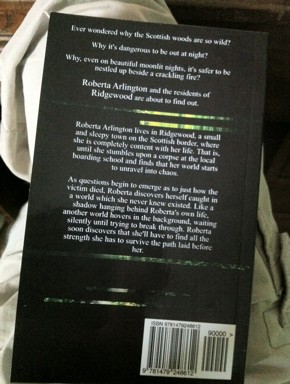
2. Having made the inside of your book beautiful by using the easy process above, it’s time to do the cover. There are MANY tutorials on the web which show how to make extremely good but complicated covers. If you have some cover art ready made, use the CreateSpace online cover editor.

If you scroll through the template options that they give you, there are a few blank ones that you can use. Simply update your information for the spine, use your cover for the front and utilise Photoshop, or something similar, to make a back cover. You might have to make a few corrections so that no text spills into the gutter lines but CreateSpace makes this very obvious so you know when you’ll need to change something. Your back cover also doesn’t have to be complicated – at all – and all I did was to overlay a black raster layer on top of my front cover, cut through to create a few lines of colour, and add the same text that I use for my sales copy.

*Note* – CreateSpace GIVES you a free ISBN and sorts out the barcode image on the back of your book. Don’t stress, they do it for you! 😀

3. After you’ve done your interior and cover, you’re pretty much done. The team of reviewers will look at your work, after which point you have the option to order a Proof copy or just proof online. I was tempted just to proof online, but ORDER A PROOF COPY. Here’s why:

– Because I’d used my Smashwords .doc, I’d forgotten to put my headers and footers back in. Therefore, Inside Evil had NO page numbers.

– My About Author section still said ‘ebooks’, when it should have said ‘books’.

– You need to check your cover prints correctly. Just because it looks great on your computer screen doesn’t mean it will be perfect on the book.

– Your ebook font size and spacing may need changing. My font is size 12, with spacing set at 1.5 lines. Whilst this is OK, I’m trying another proof with normal spacing. This will reduce the number of pages, therefore making it cheaper for readers to buy. It’ll also look better.

– Holding the first ever printed copy of your book is AMAZING. I have no page numbers, an author error and PROOF written across the last page, but I love it.

Using CreateSpace is really easy to make your paperbacks, and I highly encourage it. Now that I’ve done a first proof of Inside Evil, I’m going to make a few changes and get another proof done. I’ve also spent today getting the The Tower of Souls ready for publication. Will I sell any paperback copies? Who knows. Will I love having MY books on MY real bookshelf? Yes.
Edit, edit, schmedit.

Whilst stories and ideas tumble around in my head for the third instalment of Inside Evil, the editing process continues with gusto for the new science fiction title. Whilst a name is still to be confirmed, I’m making good process. About 10,000 words got edited today, and I’m about 50k in – just another half to go. The end of the novel also has to be finished. Like Inside Evil, I wrote this story over several years and have therefore become distanced from the work so am having to reacquaint myself with the characters through a first general edit so that I can tie the end of the novel up nice and neatly. I’ll need to write/rewrite about 10 – 20 thousand words to complete the book, at which time another edit will be needed. But, what is my editing process?

When I read through a manuscript I do  make punctuation and grammar changes, but I leave the majority of this work to my proofer. She’s there to call me out on bad words, questionable sentences and a host of spelling mistakes, missed words and comma misplacements (the latter, I know, I’m pretty awful with). My main focus for an edit is to ensure that the story flows, to make sure that a character’s inner voice doesn’t get too annoying. ‘CRYO’ sees an ordinary man win the trip of a lifetime, a chance to start again in a fresh and new world. He’s disillusioned with the current state of his dying Earth, and sets off to find a new utopia. One area that I’ve been battling with in this work is my protagonist’s whinge.  Yes, he hates the world, he wants to leave, he wants a better life. But, there’s a careful balance between expressing his thoughts and making readers want to throttle the bugger.

I’m excited about getting this novel out there, and the current timeline will probably see the final manuscript having a second edit during Oct, proofing during Nov and publication in early Dec. Then I’ll get back to Inside Evil and start formulating the increasing wad of notes around my house into a sensible story! But, for now, here’s the first 250 of my WIP (subject to change – of course):

Title: TBC

The sales assistant, a gangly and short youngster with a metallic silver tattoo beading its way through his eyebrows, stared over the counter, open mouthed and wide eyed. John’s pupils dilated, his skin became momentarily flushed. Excitement, anticipation, disbelief; his face expressed it all. Wednesday morning, 12 minutes past 10, nothing had been planned for today, nothing was supposed to happen or to have happened, but in the cashier’s hand was something that could change everything. No, it would change everything.

Time had slowed to a grinding halt. John’s mind contorted as it tried to process this split second in time, trying to stop itself from exploding due to the multitude of mixed of emotions that John was feeling at this precise and tiny moment in time. Emotion seeped through his veins, pumping his heart with power, a deep resonating booming in his chest that he was sure the whole world could hear. Minute sweat beads began to form on John’s temple, his skin flushed, causing every hair on his body to become aroused. Around him people were shopping, laughing, living, queuing, fighting, crying, and in the midst of it he stood silent, an ordinary chap, on an ordinary day, with one extra unordinary feeling.

Defining genre for indie authors

There was once a time when the big six practically ruled the literary world, making authors famous, rejecting great books on a flippant whim and creating their own specific genres that writers had to adhere to if they wanted even the slightest hope of publication. I’ve heard many stories of authors who’ve had to significantly alter novels or remove entire story threads so as to appease the literary powers that be. Then, Amazon said ‘hang on, lets enable authors to publish their own books and take a cut‘. The self publishing indie world was born, free of restrictions, enabling authors to write what they wanted with no compromise. However, in the sudden rush of this literary bandwagon it seems that both Amazon and many readers have failed to keep up with the changing genres, often making it very difficult to place your book into the right category.

It seems that many good indie authors, authors who have written amazing novels and are doing well, as still finding difficulties with defining their genre. Numerous problems seem to be rife with romantic books in particular; even if your entire 400 page novel is bursting with romanticism, if the lovers don’t end up together, then your book is not romance and you will feel the wrath of many a reader. Readers are the indie author’s life force, offering the means to keep writing and share their work. But, there can often be a very stringent unsaid code of conduct to write by if you want to please the majority. Of course, there are readers who like the break from the mould, the chance to read something a little different, something refreshingly new, but in altering the traditional format, you may find yourself risking a backlash.

I’ve had particular problems defining Inside Evil myself. There are fantasy and paranormal elements scattered throughout the book, but many readers of this popular genre are looking for werewolves, vampires and fairies, of which NONE appear in my tale. Instead, a mystical tome offers intrigue, an evil curse lurks awaiting another victim, another realm’s ‘gatekeepers’ follow ancient customs to keep demons at bay. I sail perilously close to mentioning spells and some characters do entertain supernatural beliefs, but for a reader wanting a witchcraft read, once again Inside Evil does not quite fit the bill. Parallel worlds are often used in science fiction, but again, though there is another realm in Inside Evil, it is certainly not one that lives in the sci-fi genre. Then, there is the horror and occult aspect of the book which, though not apparent in full visceral force, does provide an underlying tone. But, for those wanting full throttle horror, once again, Inside Evil may not be the right genre. It seems that I’ve written a novel which fits into many, yet no traditional genres. Though the eclectic cast of characters offer a unique and page turning story, traditional readers may remain unsure.

Indie publishing is a godsend for people like myself who want to share their work with readers without having to deal with creative oppression. However, even Amazon itself is has so few categories within their Kindle listings that they seem tied to the very stereotypical genres that have been forced into society by traditional publishers. Whilst the traditional author might have to write a, b and c to create a perfect thriller, the indie author might take out b altogether and throw in a couple of wayward z’s to the mix. Just to liven things up a bit. Just to refresh the genre and offer something unique. But, it comes with the risk that you may divide readers, causing outrage from traditionalists and clamouring fans from modernists.

There are many indie authors whose works easily falls into a specific genre, making their lives far easier. However, for many, like myself, who have forgone the carefully constructed genres of the past, the world may be our oyster, we just have to work a little harder to try and define ourselves. Meanwhile, readers will remain vital in helping to break the traditional restrictions so that authors feel free to offer something new. In the meantime, I’ll keep trying new genres for Inside Evil and taking feedback from readers to help discover its best suited category, but until then, it seems that many will either love, or hate, novels which break the norm.

Increasing Smashwords success

When I first came into self-publishing, I didn’t even know about KDP Select. I find myself feeling fortunate about this because whilst many authors noted a lot of success at the beginning of Amazon’s exclusive deal, I’ve read quite a lot of material lately that has suggested that the perks of the arrangement are beginning to wane. Instead, I uploaded to KDP and Smashwords, got into the latter’s premium catalogue and pushed Inside Evil onto the shelves of distributors like Apple, Sony and Barnes & Noble.

There are a number advantages of going with Smashwords, including that they issue payment when you have a minimum of $10 through Paypal, rather than waiting for a minimum $100 cheque balance for foreign publishers (or aliens as America likes to call us) that Amazon requires. Likewise, because I’m based outside the US, I can’t access B&N’s own PubIt, so have to utilise Smashwords to get on their shelves. I don’t own a Mac, so directly uploaded to Apple’s iBooks is impossible, and though Kobo have just released their own publishing tool, I’m yet to use it.

Whilst I’ve used Smashwords to offer codes for freebies, I had NO actual sales from the website itself. I thought it was going to take years for me to ever get the $10 minimum, and with no distributor sales either I was beginning to think it was a lost cause. That was until this month, however, when BAM, I had four B&N and three Apple sales. OK, these numbers aren’t high, but I’m in self-publishing infancy, am doing no advertising for those platforms and am not selling huge amounts on Amazon either. In fact, for July, with those seven distributor sales, I actually made more at Smashwords than at Amazon.

Now, I’m finally happy that I’m utilising Smashwords to distribute Inside Evil across its channels, and for the first time, a few sales seem to be appearing. After the first few months of practically selling nothing, sales are actually creeping up each month; a welcome trend. Do you use Smashwords? Have you noted growing sales at distributors?

How to get 1,000 Ebook sales

How to get 1,000 Ebook sales? That’s a question I often ask myself. Look around the various blogs about self publication, and it seems to suggest that once you’ve hit around 1,000 sales on Amazon, the website’s algorithms will take over and help to make your work more visible. Note that this isn’t total sales, but sales for each title. While, of course, selling more of one title is likely to help sell other works too, pushing up your overall sales figures, it is 1,000 per book that you’re aiming for.

This can be an astronomical figure to reach, especially if you’re only selling tens of books per month. Inside Evil was published in March and I’ve not yet cleared the 100 sales barrier. Interestingly, in my latest giveaway on Elle Casey’s blog, Inside Evil was one of the most sought after titles, so the book itself seems to be in demand and attracting attention. It just doesn’t get noticed by people browsing on Amazon. And, without a lot of luck, I’m warning you, growing to 1,000 sales will be hard work.

But, how can you achieve this feat? How can you reach that target? I’m not entirely sure myself, having not gained those dizzying sales heights yet. There are variety of methods that I’ve come across, and some may work for you, others may not. Here’s some of my findings.

Forums

Some people advocate joining lots of forums, putting your book in your signature and then talking, continuously, about yourself and your work. This doesn’t work and WILL NOT SELL ebooks. You’ll quickly get a spam notification and be ejected from the boards.

However, there are some forums that you might be persuaded to join, such as Kindleboards, the official Kindle forums at Amazon and the Kindle Users Forum. Whilst you’ll get all manner of help and tips at these places, I wouldn’t look for a lot of sales here. Generally, these boards are occupied by people like you; authors wanting to find how to sell ebooks and unlikely buyers.

LibraryThing & Goodreads

My use of LibraryThing and Goodreads has been haphazard at best, largely due to the fact that I hate both website’s interfaces and I find joining in conversations extremely confusing. LibraryThing is great for doing giveaway’s, but though I’ve noted a few reviews trickling through, these haven’t turned into sales. Meanwhile, though I’ve had a very few ‘adds’ on Goodreads which may have possibly led to a miniscule number of sales, my Goodreads ad campaign was a complete failure and I didn’t make one sale from the investment.

Word of Mouth

This is a very obvious way of selling, but if you don’t tell anyone about your book, then how can you expect sales. Word of mouth is vital for sales. Tell friends and family about your book. When you go to parties and meet new people who ask what you do for a career, tell them about your writing and mention your novel’s name..who knows they might just go home and download it. Put a link to Amazon in the signature of your email so when you’re emailing people, you have an unobtrusive marketing ploy ready to go. This has been my best sales tactic to date, helping to push Inside Evil higher in the Amazon charts and therefore being more noticeable.

Twitter

Some people swear by it, others don’t, but I have found that Twitter has got me sales. I have recently opened a new Twitter account devoted to only my writing. Whilst I have a personal account with over 1,000 followers, I tend to have verbal diarrhoea on that feed, and whilst those 1,000 followers don’t care about me talking non-stop about the Olympics or saying slightly rude things when I’ve had a glass of wine too many, I really don’t want my main group of readers and authors bombarded with this. Of course, many may want to, so it’s worth tweeting that you have another account, but to keep all my professional and book related stuff in one place, I now use GWakelingWriter.

One of the good things about Twitter is that you can easily interact with readers. If someone tells you they’ve bought your book, thank them, ask them for feedback. RT their comments if they’re positive reviews. Use Sample Sunday (a writer’s RT group which helps spread book samples on, you’ve guessed it, Sunday’s) to reach a larger audience. Use Writer Wednesday to follow and RT other writers. Most of all, ensure that the majority of your tweets are personal, RTs or links to informative articles rather than constantly links to your own work. This will turn people off immediately, and your Twitter account will never get off the ground.

1,000 ebooks is a hard task…

Selling ebooks is no easy task, and shifting these first 1,000 ebooks is monumentally difficult. I read blogs all the time offering advice on how to get sales, with each and every post saying, ‘once you’ve reached 1,000 sales you can use X, X and X to get increased earnings,’ but what about the climb to 1,000? What about the depressing screen of Amazon’s Beige Bar of Shame when it’s staring at you mid month because you’re yet to have  a sale? What about selling five or 10 copies a month and realising that it’ll take you years to reach that elusive 1,000?

I’ve used the above processes to get a few sales here and there, but nothing that has finally swept me along at pace. I’ll soon be releasing a new book, The Tower of Souls, and I’m hoping that it’ll attract more people to the series. However, for the meantime, it’s the slow plod along. What do you use to try and increase sales? Found any tactics that worked? I’d love to discover new areas that I haven’t tried…and we can all look forward to pushing our sales and cracking that 1,000.

The importance of choosing the right book reviewers

Getting readers to review your books on their blogs is a great way of spreading the word. I have to admit that I haven’t seen a huge spike in sales after reviews are released, but it is a good way to get your title’s into readers hands. This is especially true if you have a number of titles because even if none of the book review readers buy your novel, perhaps the book reviewer themselves will come back for more.

There are huge lists of book reviewers to be found on the web. A great place to start is the Indie Book Reviewer, a place where you can find hundreds of eager readers who want to take your novel and blog about it. As you go through the listings you’ll discover that many people are simply swamped with books and cannot take on more reads, resulting in your pool of possible reviewers shrinking considerably. This can cause you to simply contact everyone that is open to taking on books. However, this may not work to your advantage; a fact that I found out this morning.

There are always going to be people who don’t like your books. Fair enough. I don’t like every book that I read either. However, it is important to try and choose reviewers who have a great looking blog, lots of followers and who are actually interested in the genre AND style that you’ve written in.

This morning I had a three star review from a reader who mentioned that Inside Evil’s pacing wasn’t very good and that there wasn’t enough back story in the book. Looking into her history, I saw that she marked similarly for all books which didn’t give back story or lots of superfluous information. She also mentioned that it took her longer than normal to read the book because she just couldn’t get into it. In my rush to find reviews, I’d simply just found a name, an email and sent the book out. Of course, EVERY reader is entitled to their opinion and I’m grateful for the honest review, but if I’d done my research, I would have discovered that perhaps this reader wasn’t the best candidate for my work.

You can then compare this to the wonderful four star rating that I also received today from The Book Barbies. Whilst the pacing was slow for the reviewer mentioned above, the reader at The Book Barbies couldn’t put it down. She was devastated by the cliffhanger and is ‘dying in anticipation for the next book’. She even had a dream about the book after she’d finished.

You can never tell if someone’s going to love or hate your work, and it’s important to not become too bogged down by the details. After all, Twilight has 715 ONE star reviews on Amazon, The Hunger Games has 501, and even Harry Potter and the Philosopher’s Stone has 88. However, when you’re searching for book reviewers, it can be worthwhile to take some time and establish a reader’s back history of reviewing and the genre and style’s that they love. It could make or break your resulting write-up.

The Difficulty of a title

As you may have discovered in my previous post, I’m setting about finishing a science fiction novel that’s been cluttering my computer files for far too long. I started reading it today and really enjoyed it – ok, I’m very biased – but I very quickly got back into the characters and story. I do have one problem, however, in that the new work has no name.

A title is pretty darn important. Inside Evil was always there from the beginning and worked so well as it can be interpreted on various different levels for the book, from the ancient evil lurking in the woods, to the inner conflict that many of the characters have throughout the story. Likewise, The Tower of Souls came to me as I was writing and I now can’t think of any better title for the second in the series. However, the latest work just isn’t coming along.

Self publishing means that I can flit in and out of published works, change inaccuracies and errors when they’re highlighted, add appendices and epilogues as needed and even, as I’ve just done, change the listings to create one book into a series of books. However, a title sticks. It can be the first thing that readers see and so it’s essential to get it correct. Along with good cover art, an alluring title can persuade people to delve more into the details of a book and hopefully make them buy it.

The problem with my latest work is that I’ve already written it and nothing enthralling has come to mind. I have a working title, but it’s pretty bland and boring, and if I think that, then god only knows what readers will think. Perhaps I’ll pass it to my proofer with the title TBC, perhaps something will come to me, or to her. But, until that crucial element of self publishing is decided, cover art and the ultimate publication is going to be seriously held up!

The Next Project Begins

The Tower of Souls is done and has now been given to my proofer for a final once over. All being well, it’ll be on shelves in the next few weeks, furthering Roberta and the residents of Ridgewood’s stories. So, with the manuscript completed, my mind is already moving to new things.

My next project will be a slight departure from Ridgewood as I complete the science fiction novel that has been lurking behind the scenes for many years. It’s already at 80K, and will probably end up at about 110K overall. I’m not very good at writing stand-a-lone stories as I get far too involved in my characters, and so I’m expecting this science fiction story to become quite epic.

With the title still TBC, my new project follows John Carlody; a widower who finds himself with one of the rarest golden tickets on the planet, the chance to get onto the world’s latest fad – cryogenics. The shy and retiring John finds himself thrust into the limelight, filled with mixed emotions over saying goodbye to those he loves and thrown into a future unrecognisable to the one that he left.

I’m excited to get back into this book and rediscover the characters who have been in my mind for so long. I’m aiming to have an Oct/Nov release, after which I’ll be back with the Ridgewood residents for the third in their series.